
The real challenge of emerging science
Accepting hard evidence and acting on it when the facts challenge the existing dogma

Since January 2015, thanks to the words of Prof. Francesco Piantelli (“Don’t tell nature what it is, let it show you”), my main approach to Low Energy Nuclear Reactions research is that if you can’t repeatedly observe it, it probably is not a thing.
During this time I realised that vortex ring solitons and the tornadoes they can produce are possibly fundamentally important to the way our universe works. Of course at this level, I am not original. Indeed William Thomson suggested in 1867 [1] that matter formed in a perfect fluid as vortex-rings. From extended studies of smoke rings, he hypothesised that atoms repelled each other in a similar way to their physically observable counterparts and that different elements could be explained by knots in these vortex rings. Of course, this was before even the electron had been discovered.
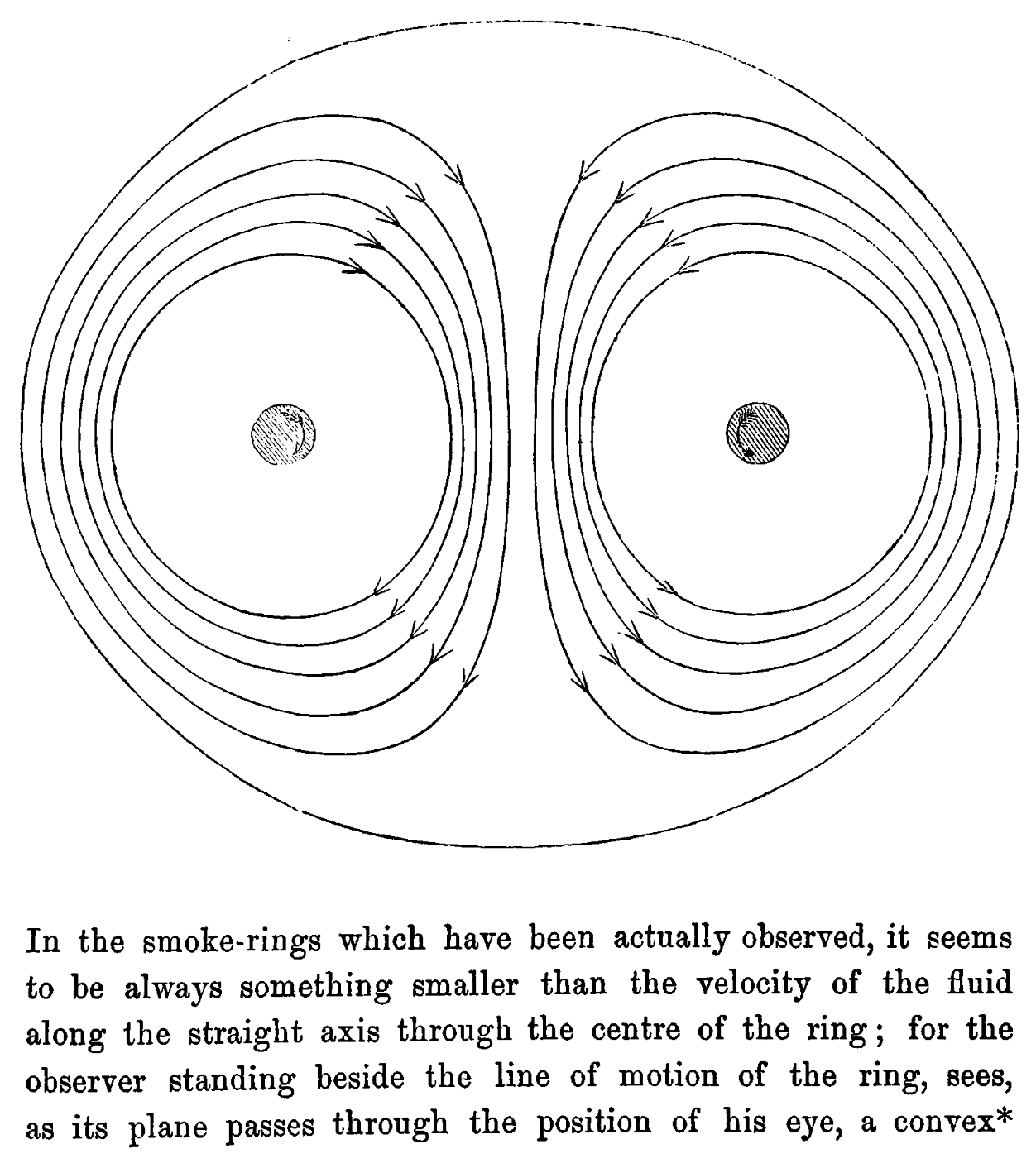
In 1905, 38 years after William Thomson’s proposal, the then called Lord Kelvin, faced with the emergence of the periodic table making his knot theory impractical and the recent discovery of the electron explaining charge based repulsion, chose to withdraw his conviction about matter being made of aether vortex rings [p. 565 footnote in reference 2]

Essentially, the proponent of the Aether vortex theory of matter, could not see how the energy in structures would maintain stability and not radiate and dissipate into the far field as could be seen in basic hydrodynamics in water.
My own brush with hydrodynamics
For my A-Level physics practical, my friend Alan Frost and my-self carved boat hulls from wood, prepared a 1/3rd of a tonne water tank and, by way of a pulley mounted at one end of the the tank and a rope attached to the test boat and the other to a weight that fell under gravity, we measured the acceleration and terminal velocity (if possible) of the various bow shapes we had made. This was my only scientific consideration of hydrodynamics until witnessing the ‘sprites’ in Suhas Ralkar’s ultrasound laboratory on March 4th 2017, some 27 years later.
I was fascinated by these travelling standing ultrasound wave driven self-organising toroidal forms and how they interacted with one another. It was to start me on my road to understanding the potential role of magneto-hydrodynamics in Low Energy Nuclear Reactions and much more.
Knowing that plasma is scale invariant and having studied various video frames and witness materials of experiments [3], I realised by January 2018, that charge separated material undergoing multi-axis hydrodynamic shear might produce fractal arrangements of toroidal vortexes that would have the ability to self-sustain for periods of time if built to a certain level and maintained if given a little extra energy every now and again. This insight was explicitly confirmed a number of times, most particularly by Bogdanovich et. al. [5] in 2019 where ‘plasmoids’ were recorded to persist in a light emitting state on metals for a few days after they had been produced.
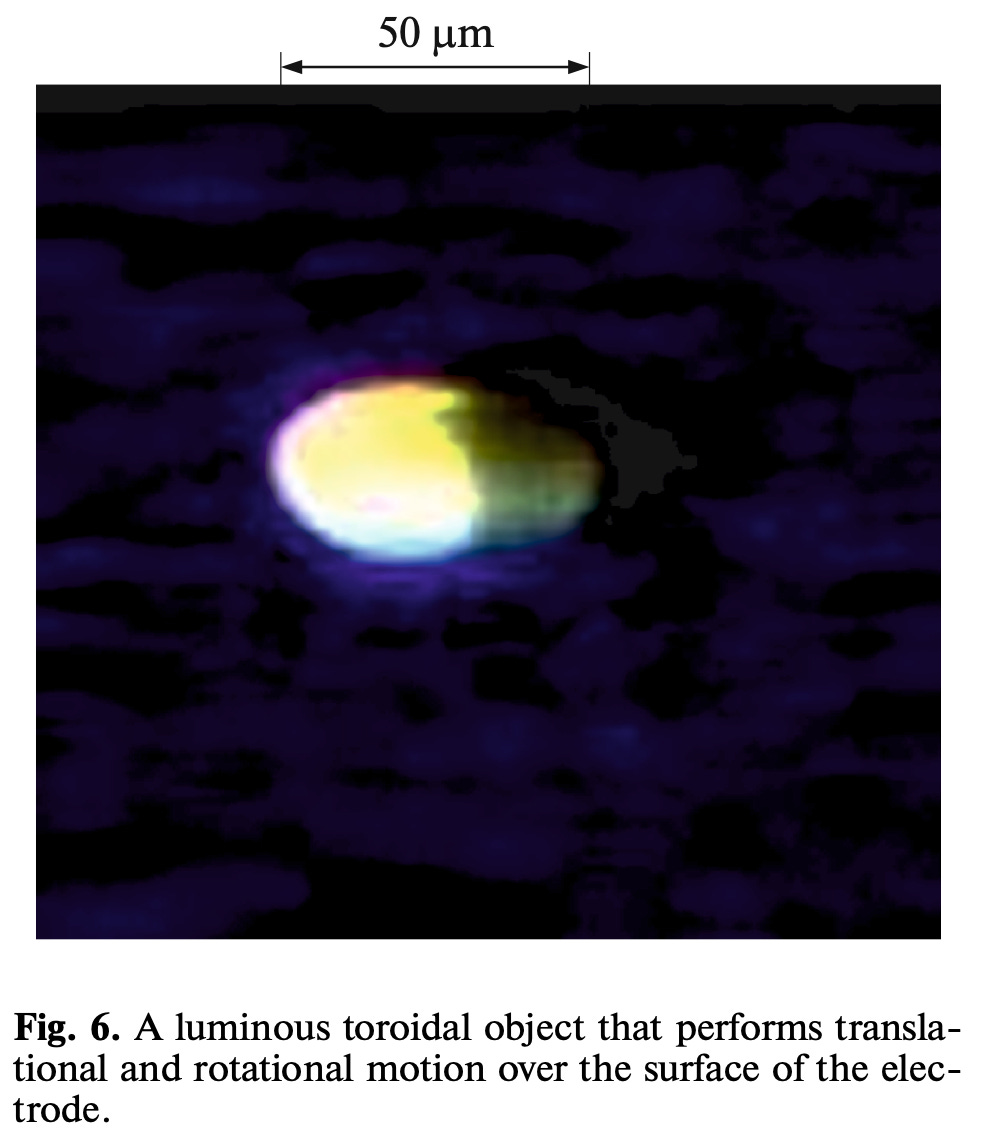
Of course the term plasmoids was created by Winston Bostick out of the United States Department of Energy fusion research. It is in my view, an abbreviation of the words PLASMa and torOIDS. In Bostick et. al., the structures were at least formed from two plasma toroids, in the image below published in 1956 there are four [5]
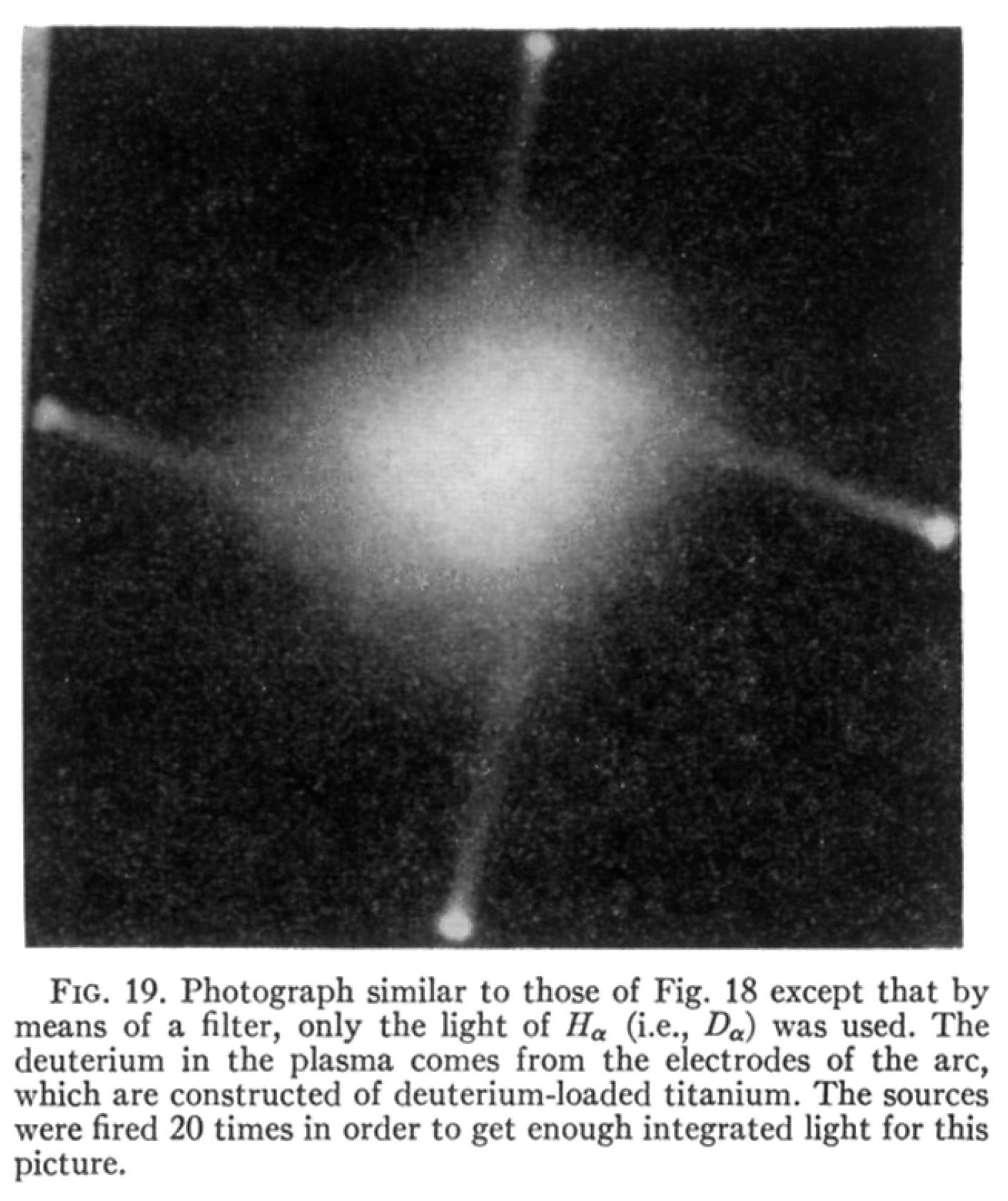
This explicitly showed me that thinking of these things as toroids of toroids may be the right path. Only after finding the aftermath of such things in Henk Jurrien’s VEGA reactor witness materials [6] did everything become clear. This lead to the translation of the papers of Zhvirblis [7] and Nevessky [8] and the recognition of similar later work by Fryberger [9]. Later, amongst other papers, Yue, D. N. et. al. [10] revealed the extreme charge separation and magnetic forces that could be present in these structures. These works however, do not detail the overall magneto-hydrodynamics (MHD) of the processes.
In my mind there could be a fractal nature to the process that leads to these self-organised structures being able to self-feed to a degree and be sustained if given a little extra every now and then. It was predicted [11], that these fractal Wheel within Wheel within Wheel (WwWwW) driven structures and their fractal toroidal moment would be behind the excess heat and element synthesis in the Huang et. al. cavitation reactor [13]. It was proven to be the case following subsequent analysis of samples from the cavitation reactors [14].
I hypothesised that it is the ability for electro-magnetic energy to be condensed via closed pointing vectors without dissipation as calculated by Nevessky [8] and Fryberger [9], within these structures that endows them with long life and unusual properties. The loci of the energy storage is at the phase singularities created by the fractal toroidal moments.
What I mean by Fractal Toroidal Moment (FTM)
My friend and colleague Phillip Power who worked with me to develop the Martin Fleischmann Memorial Projects (MFMPs) LENR reaction calculator [15] based on the work by Dr. Alexander Parkhomov, asked why I called it the FTM. I answered as below.
I call it the FTM predominantly because it is (1) self-similar and has (2) essentially infinite detail - scale invariant, however, if we are to say the following about fractals.
A fractal is defined by these five main points:
Self-Similarity: Parts of the fractal resemble the whole, at different scales.
Infinite Detail: Zooming into a fractal reveals more detail, with no limit to the complexity.
Non-Integer Dimension: Fractals often have a fractional dimension, not fitting into traditional geometry's integer dimensions.
Recursive Generation: Many fractals are created through recursive processes where a simple rule is applied repeatedly.
Complex from Simple: From simple rules, fractals generate highly intricate structures, often appearing chaotic or naturalistic.
4 and 5 are easy to see as being present, though, the recursive nature of the structure is at each level orthogonally arranged, which is part of the 'simple rule'
3 is not intuitive, however, when you understand that it does not fractally arrange on the NRB (which are regular spheres) but in the apple, which is replete with golden ratio and I believe is the reason for this ratio appearing in natural forms, it makes sense. Whilst scaling with φ does not define a fractal, when it is combined with self-similarity and essentially infinite detail due to scale invariance, in the round I believe it qualifies as fractal.
For me, the terms Hyper and Super - Toroidal Moments, as used in main stream literature, just does not explain it intuitively.
I showed these aspects for the first time on 5th Feb 2025 as I was now comfortable with the model. In the video below, I make it clear, the difference between the lack of stability of the smoke rings of William Thomson / Lord Kelvin and similar and the stability of my proposed fractal toroidal Magneto-hydrodynamic structures formed in charge separated matter undergoing multi-axis hydrodynamic shear.
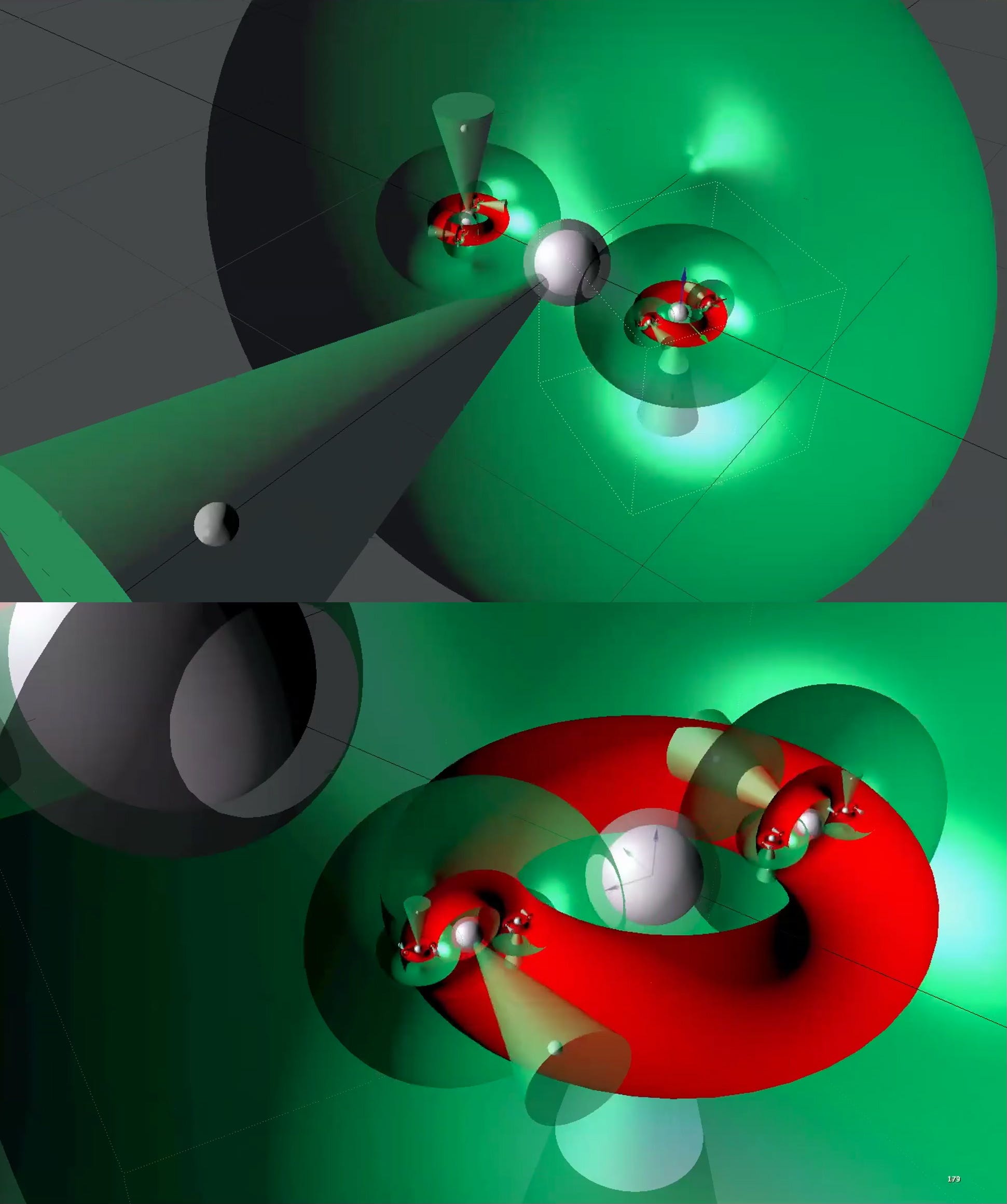
Stability
In addition to the comments given above, the stability of what Ken Shoulders called Exotic Vacuum Objects (EVOs) [16], is enhanced because they erect their own non-radiating boundary, within which the space time metrics are altered and if sufficiently energised appear impenetrable for all but the disruption beams.
It is the fractal structures in these objects that I propose prevents them from dissipating in the way that stalled Lord Kelvin’s intuitive model. I further propose that ordinary stable matter, the ordinary vacuum objects we know such as proton and electron in particular, are not only similarly structured, but are able to self-sustain and be stable indefinitely by way of breathing the necessary energy from and to the relic background neutrino condensate in the manner proposed by Shishkin, Dubovik and Kuroles [17].
These stable fractal toroidal ordinary vacuum object structures then form clusters that we know as the periodic table of chemical elements and isotopes thereof, potentially in the way proposed by Pavel Osmera or similar [18]. I believe this is possible without the need for any extra dimensions as is needed by the untestable but mathematically interesting so-called string-theory, a point Pavel makes in his latest paper [19], a diagram from which is given below.
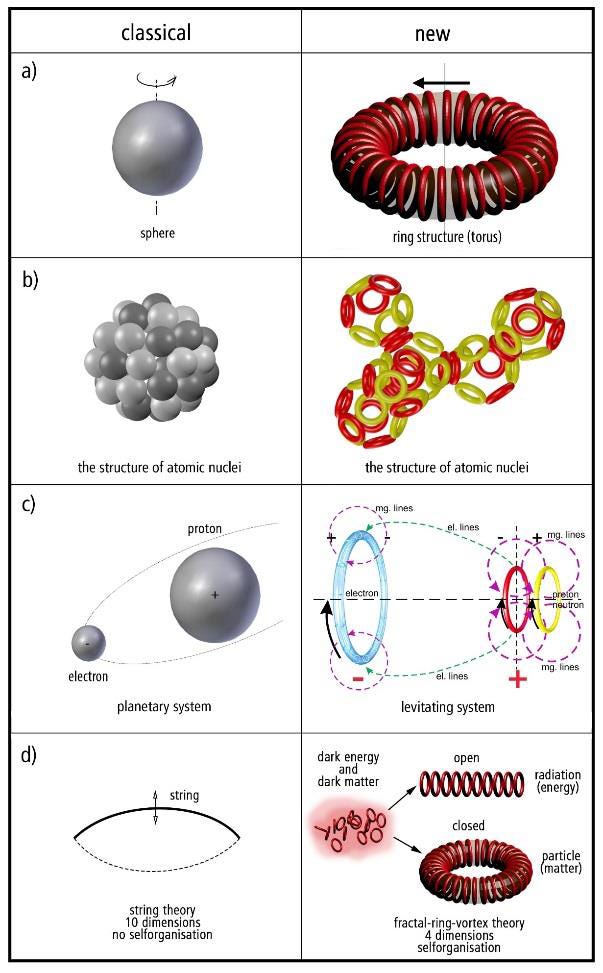
I like Pavel’s lower right box as it fits with my own understanding of how, matter is composed of fractal clusters of self-organised dark matter. In Shishkin’s latest paper on radiation [20], he notes in relation to a new form of penetrating radiation that
"quanta," of this unidentified radiation form a dynamic, closed, toroidal (doughnut-shaped) vortex structure. This structure is composed of elements from the primordial matter known as Aether. Therefore, these quanta can rightfully be called "Aether solitons" (ES).
When referring to this radiation structure in the context of his prior paper [17], Shishkin notes that dark matter in the form of background (relic) cold neutrinos are elementary inductor-capacitor (LC) dipoles and effectively states that one electron is made up of 0.89*10^10 of this elementary LC dipoles.
Why did I write all this?
I was inspired to write this because of the following video by Sabine Hossenfelder which mirrors my own experiences with academia and people stuck in a paradigm.
I am pretty sure she is referring, at least in part, to scientists working in the field of string theory, which as I note above, requires 10 dimensions (at least) for the elegant maths to work and is practically untestable.
The collective work by myself and other authors above re-frames the formation of stable matter based on the scale invariance of physically and repeatably observable physical phenomena. It is reliant on the vortex and solitons that arise from vortices, the only structures that I believe allow for negative-entropy in nature. I have argued in the past years that this no extra-dimensions, intuitive approach, can also explain inertia, gravity, variable atomic decay rates, the ‘perpetual motion’ of the electron in an atom and even extra sensory perception.
I and everyone above may be wrong however and since I don’t know a lot about string theory or the motivation behind ‘point like’ particles that are critical to mainstream physics, I thought I would question an aggregator of accepted scientific orthodoxy in the form of one of the better AI models out there, GROK 2.
I think you will be interested to read how that went, if so, click here.
Thank you for your attention.
References
William Thomson (later Lord Kelvin), "On Vortex Atoms", Proceedings of the Royal Society of Edinburgh, V6, pp. 94–105 (1867) {reprinted in Philosophical Magazine, V34, pp. 15–24 (1867) (Download original paper)
Lord Kelvin (formerly William Thomson), “Deep Water Ship-Waves”, Proceedings of Royal Society of Edinburgh. 1906;25(1):562-587. doi:10.1017/S0370164600008749
Robert W. Greenyer, “The New Fire - Are we there yet?” Aug 07, 2022
Bogdanovich, B. Y., Volkov, N. V., Len’, N. A., & Nesterovich, A. V. (2019). “Video Recording of Long-Lived Plasmoids near Objects Exposed to Remote and Direct Effects of High-Current Pinch Discharges.” Technical Physics, 64(4), 465–469. doi:10.1134/s1063784219040066
Bostick, W. H. (1956). “Experimental Study of Ionized Matter Projected across a Magnetic Field.” Physical Review, 104(2), 292–299. doi:10.1103/physrev.104.292
Robert W. Greenyer, “VEGA - Bagel Mania”, May 13, 2022
Zhvirblis, V. E., (1995) “The Bagel Game”, Chemistry of Life
Nevessky, N.E., (1993) “Electromagnetic fields of current structures” Electricity Journal of the Russian Federation.
Fryberger, D. (2009). “A Ball Lightning Model as a Possible Explanation of Recently Reported Cavity Lights”, Stanford Linear Accelerator Center, SLAC-PUB-13583
Yue, D. N., Chen, M., Geng, P. F., Yuan, X. H., Weng, S. M., Bulanov, S. S., … Zhang, J. (2021). “Dynamics of moving electron vortices and magnetic ring in laser plasma interaction”, Physics of Plasmas, 28(4), 042303.
doi:10.1063/5.0034098R.W. Greenyer, “Working with nature - Possible nuclear reaction mechanism in water”, Taiwan Silicon Valley Presentation, Taipei, 13 Dec 2023
R.W. Greenyer, “O-Day - Flux capacitor”, MagicSound Lab and Alan Goldwater for MFMP, March 2024
B-J Huang et. al. “Water can trigger nuclear reaction to produce energy and anomalous gases.”, Nature – Scientific Reports, (Jan 2nd 2023). 10.13140/RG.2.2.20412.62081.
R.W. Greenyer, “O-Day - Flux capacitor”, MagicSound Lab and Alan Goldwater for MFMP, March 2024
P. W. Power, A. Parkhomov, “MFMP LENR reaction calculator”
K. Shoulders, “Electrum Validum Archive”, rexresearch.com
A.L. Shishkin, “Suggested model for the cold transformation of elements”
P. Osmera, “Vortex Fractal Ring Theory”
P. Osmera, “A pair of atoms with the same structure but with oppositely rotating protons.”, 19 January 2025
A.L. Shishkin, “A phenomenological model of radiation exposure”, 24 December 2024
Wish Sabine or Curt Jaimungal would give you a chance to speak with them!
Curt is far more open minded than Sabine in my view. She’s calling out Academia, but she’s definitely still stuck in a paradigm that needs to shift.
Curt has already delved into UAP and the Psi phenomena quite a bit. Even spoken with Sal Pais. The absolute mountain of evidence you could share would thrill him. I think it’s one of the many reasons he loves to have Michael Levin on his podcast so often, Levin has substantial evidence to back up his theories
Love Pavels image of Open and Closed structures to describe Energy and Matter..
if One were to added vorticity to a sea of energy - to close the structure loops- does matter appear?