
Ending the Nano-Thermite 9/11 Hypothesis for the World Trade Center Catastrophe UPDATE#1 - 1963 Bayer patent
With basic, easy to verify research

It is no secret that Steven E. Jones critically harmed the reputation of Martin Fleischmann and Stanley Pons. Jones was a proponent of ‘Muon Catalysed Fusion’, having published a paper in Scientific American in 1987 called “Cold Nuclear Fusion. on the subject. Hence the field erroneously received that name, requiring researchers to find neutrons, gamma and x-rays which it turns out are basically not part of the process we now call “Coherent Energy Tranformations”.
Jones et. al. own paper on “Cold Fusion” was published in Nature on 27th April 1989, just 35 days after Pons and Fleischmann’s announcement. That paper “Observation of cold nuclear fusion in condensed matter” is by far the most cited paper in his body of work.
The paper proposes a “quasi particle” in electrolytically deuterium loaded metals such as Pd or Ti, that effectively plays the role of a Muon and that this may be the cause of nuclear fusion in celestial bodies, including the Earth, that would explain observed 3He signatures. These are all ideas that I can agree with, I would suggest that the “quasi particle” in question would be an Exotic Vacuum Object (EVO)/Energy Soliton, but it does not bring the Deuterons together by electronic screening/mass difference of electron like structure, but rather by boson production, coherence and ultimately intense magnetic influences.
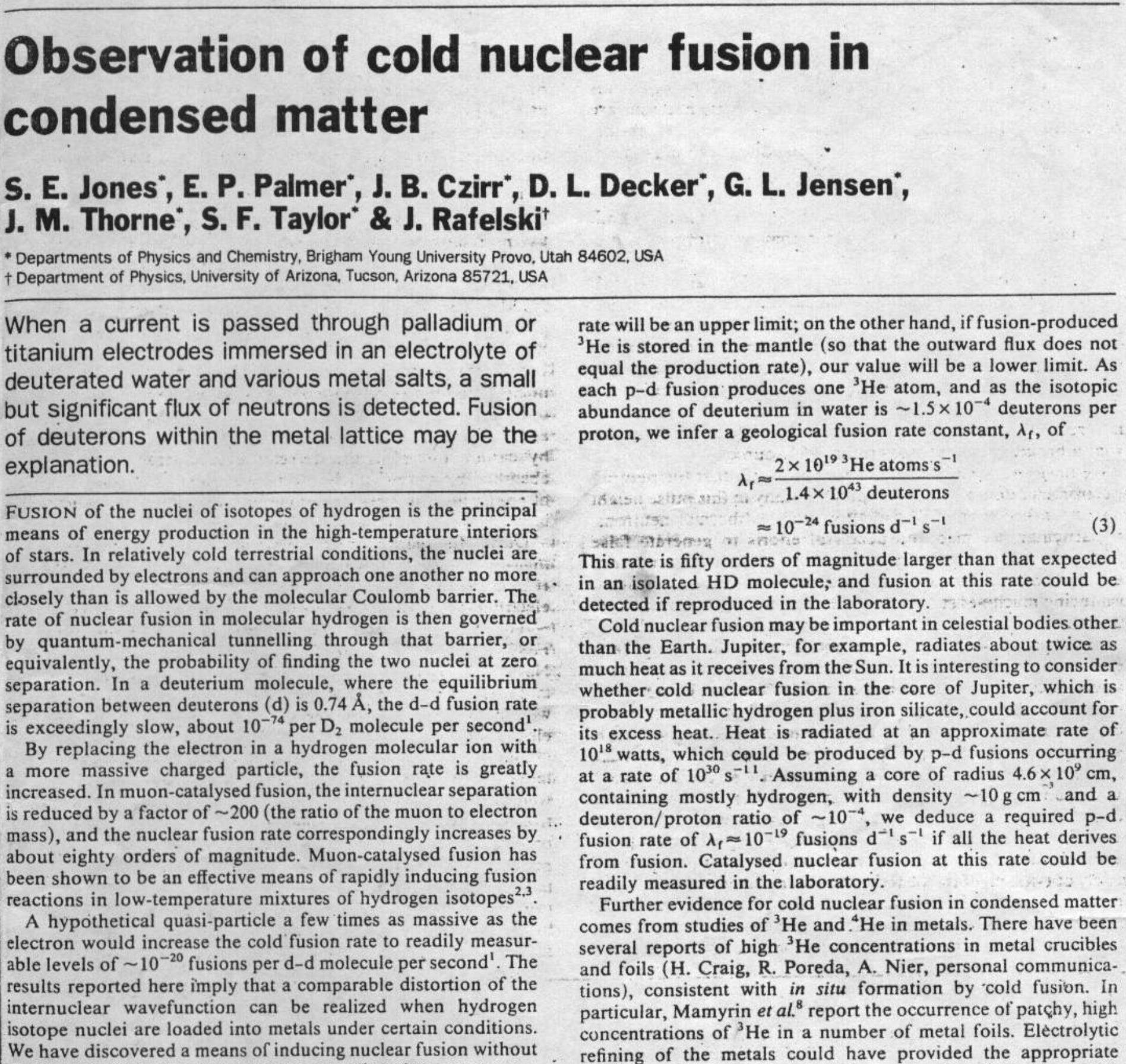
Moreover, he states in his conclusion that the celestial body “Cold Fusion” is due to “piezonuclear fusion” from his 1986 paper - and of course, we know that Piezo materials, like quartz, produce sparks and sparks are lead by EVOs/Energy Solitons. It is therefore logical to state that we now know what his “quasi particles” were.
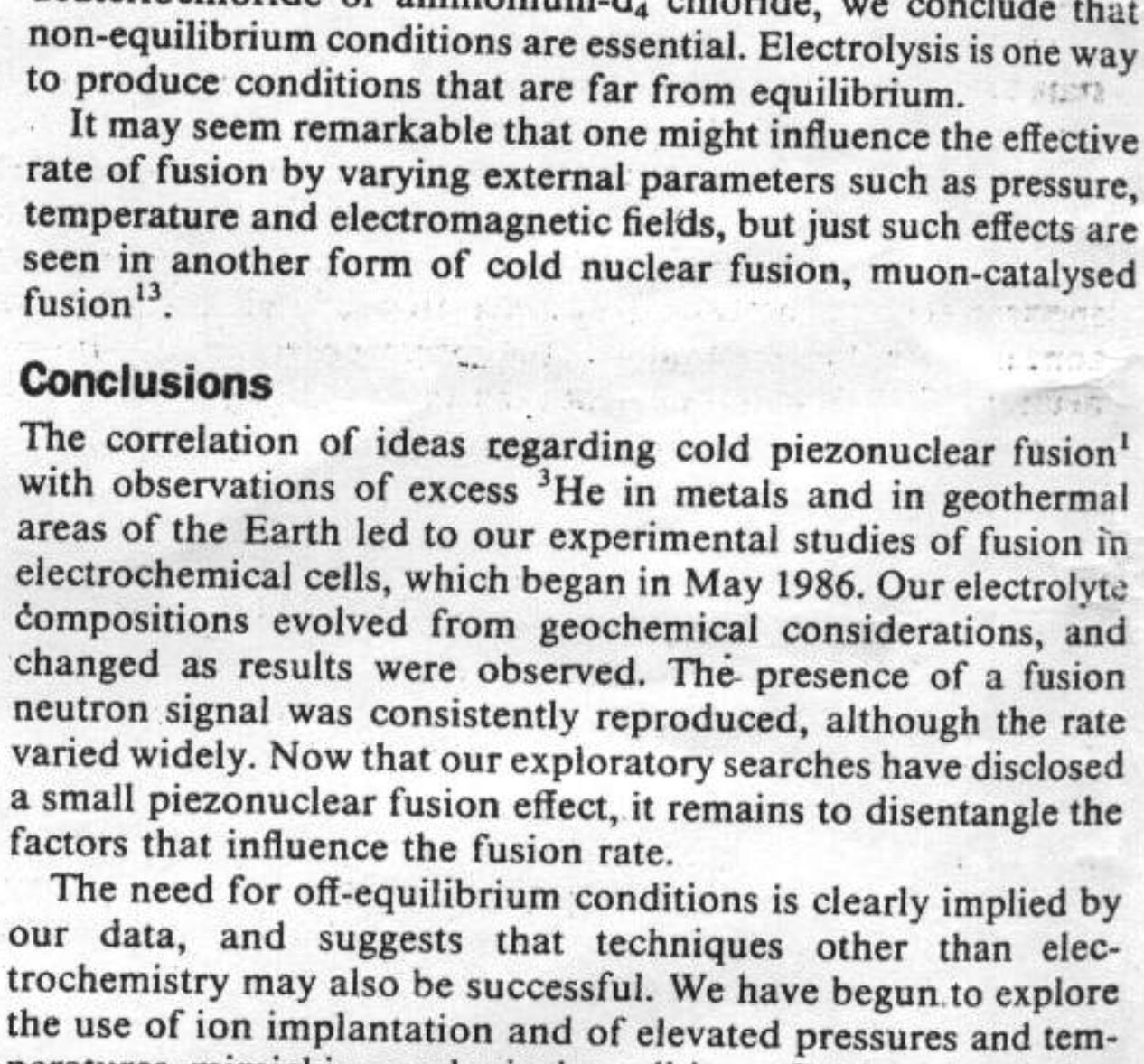
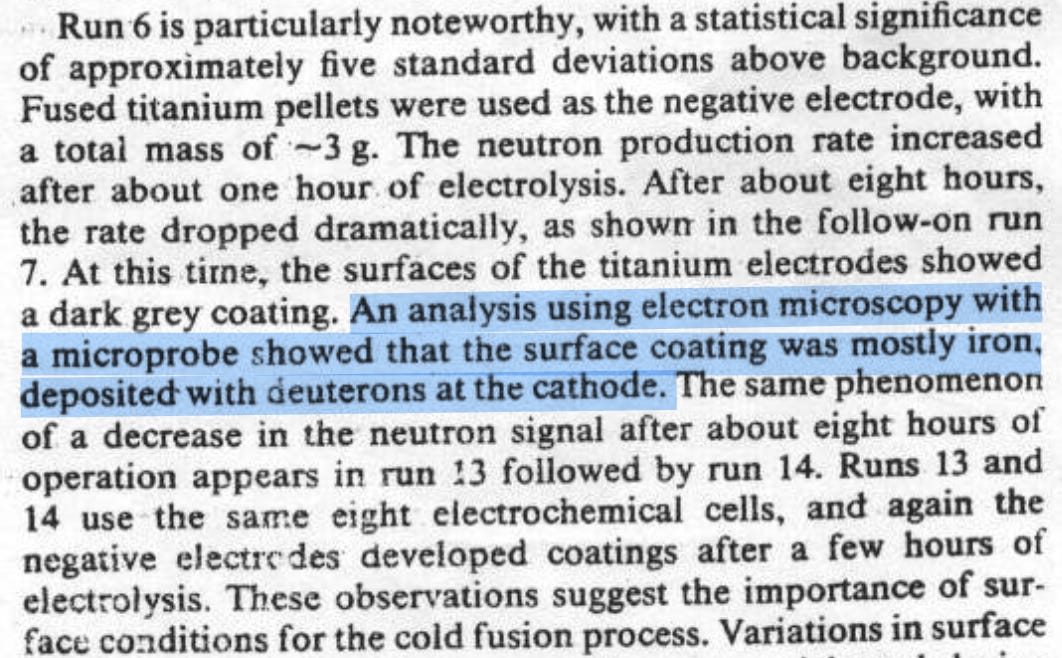
He also noticed iron deposits on the cathode, reducing its effectiveness and a neutron count depleting as the grey coating increased. Note, the electrolyte had FeSO4 in it, so the iron could not be considered synthesis, however, a topological monopole forming would aggregate elemental iron from the solution on the electrodes surface and ultimately bind further EVOs/Energy Solitons to that iron as observed by Matsumoto.
Having looked at this paper, I would suggest that the neutrons are coming from a similar source to that I have proposed for the neutrons in Kladov’s cavitation reactors when he added LiCl. I believe it is due to the interaction of EVOs/Energy Solitons with the 6-Lithium doped thin glass scintillators used in the detectors producing unstable 10Li, which basically instantly decays with a neutron, only in this case, the source of 10Li relies on the formation of quad neutrons from two deuterons as claimed by Matsumoto in 1990. The reaction taking place in the topological magnetic phase singularity core of the EVO/Energy Soliton would be as follows:
6Li + 2D + 2e- + 2 cold antineutrinos > 10Li
Subsequent practically instant 10Li neutron decay, as follows:

[Grok] The maximum energy of neutrons emitted from 10Li is approximately 0.5 MeV
(from the ground state resonance decay). The typical energies of neutrons emitted from 10Li (via resonance decay) are in the range of approximately 0.01 to 0.5 MeV, with common resonance contributions around 0.1 MeV and 0.4–0.5 MeV.
With slightly delayed 9Li decay, some of which are neutron based as follows:

[Grok] The maximum energy of neutrons emitted from 9Li is approximately 10 MeV
(from the beta-delayed neutron emission spectrum). The spectrum shows discrete peaks, with the most probable neutron energy around 0.7–0.8 MeV (from the dominant branch). Other notable contributions are at approximately 1.1 MeV and 8–9 MeV (lower intensity), yielding an average neutron energy of about 1.5 MeV across all branches.
The energy of neutrons is in the range of those observed, that said, what effect an EVO/Energy Soliton would have on any signatures is not clear.
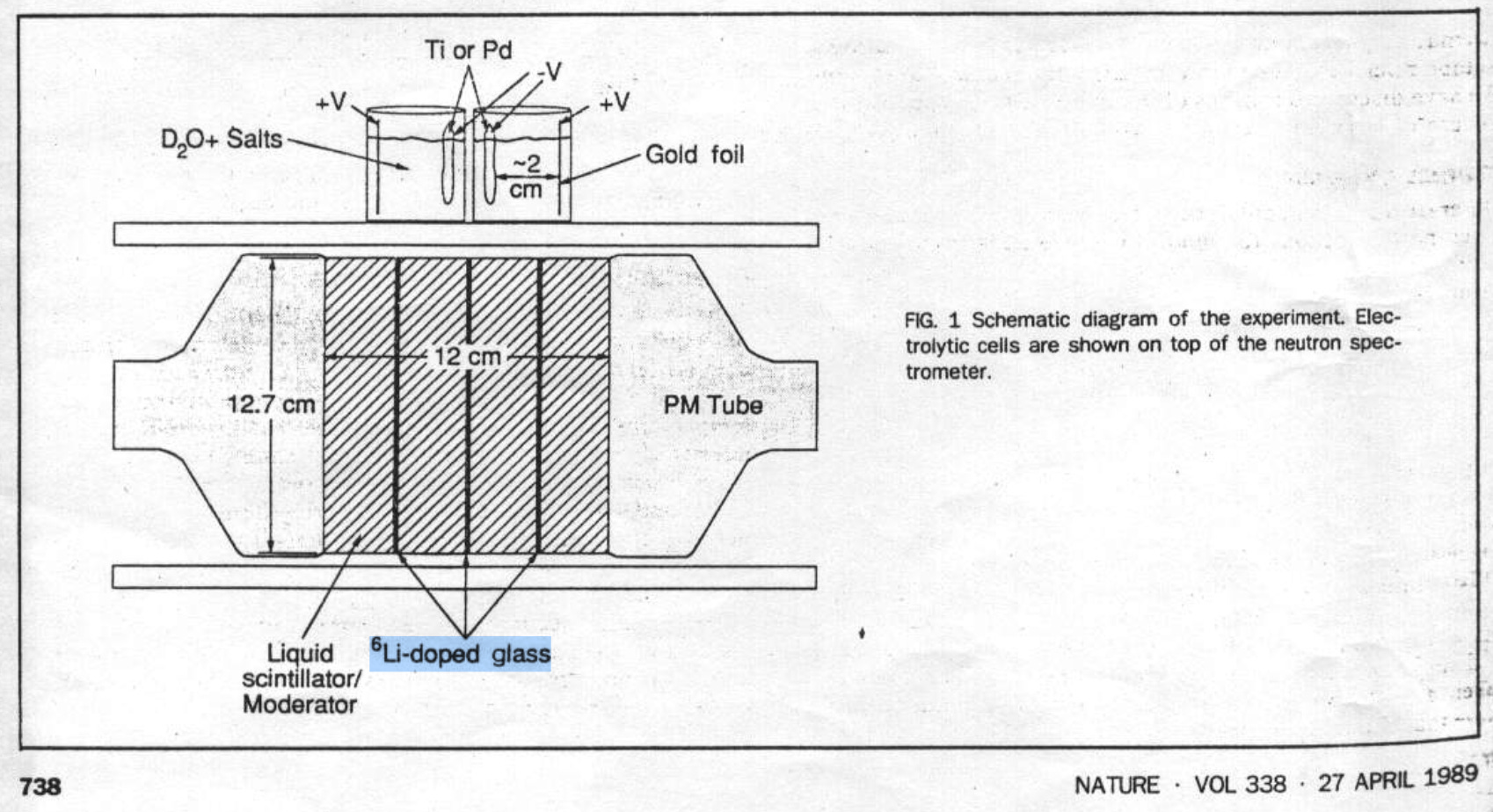
The net result in this case, would be that Jones et. al. was not finding neutrons from “Cold Fusion”, but in fact observing the interaction of an EVO/Energy Soliton “quasi particle”, carrying cohered and transformed deuterons (as a quad neutron), with 6-Li. He was effectively observing a “Coherent Energy Transformation” process in the detector.
Beyond Jones’ “Cold Fusion”
The other thing he is famous for, is the so-called ‘nano-thermite hypothesis of 9/11’. Apparently he did not believe the official hypothesis and resigned his position at Brigham Young University Utah, to investigate the catastrophe according to one source. However, Steven E. Jones was, according to WikiPedia, in fact placed on paid leave from Brigham Young University on September 7, 2006, amid controversy over his 9/11 theories.
He announced his retirement on October 20, 2006, in what was described as an agreement with the university, electing to retire to focus on his research. His retirement became effective on January 1, 2007.
Accumulated reads for his papers on the subject of 9/11 collectively eclipse all of his other published articles on ResearchGate going back to 1983.
I will show that with even a little basic research, the hypothesis proposed, based on the data argued in the principle paper, is provably explainable by simple analysis and the facts of historical understanding.
Anyone that sees this presentation will know that the Nano-Thermite hypothesis for the 9/11 catastrophe could be described as the British historian James Pettit Andrews described alchemy - as “fantastical pseudo-science.”
What is the hypothesis?
Samples of dust taken from near the WTC buildings were analysed, in it there were found to be grey plate iron oxide chips onto which a composite of nano-materials were bound that contained nano-cubes of iron oxide, nano-thin plates of aluminium and a binder, observed to contain C, O and Si.
It was proposed that this was some form of highly specialised engineered thermitic material and that this was responsible for the unusual catastrophic events on 9/11.
You can read the paper here:
Harrit, Niels & Farrer, Jeffrey & Jones, Steven & Ryan, Kevin & Legge, Frank & Farnsworth, Daniel & Roberts, Gregg & Gourley, James & Larsen, Bradley. (2009). “Active Thermitic Material Discovered in Dust from the 9/11 World Trade Center Catastrophe.” The Open Chemical Physics Journal. 2. 10.2174/1874412500902010007.
Somehow, this became the leading alternative hypothesis that caused the collapse of the WTC buildings. But does it stand up to even basic research?
Let’s end the ‘Nano Thermite’ hypothesis so we can focus on real science.
LIVESTREAMed at 22:00 CET on Sunday 5th October 2025.
I added 3 new slides that address post presentation questions that are responsive to “points not critical to nano-thermite claim”. You can see these below.


UPDATE#1 - 1963 Bayer patent
Here is a 1963 Bayer patent for a Polysiloxane based paint
https://patents.google.com/patent/US3347816A/en
It notes the following with respect to prior art
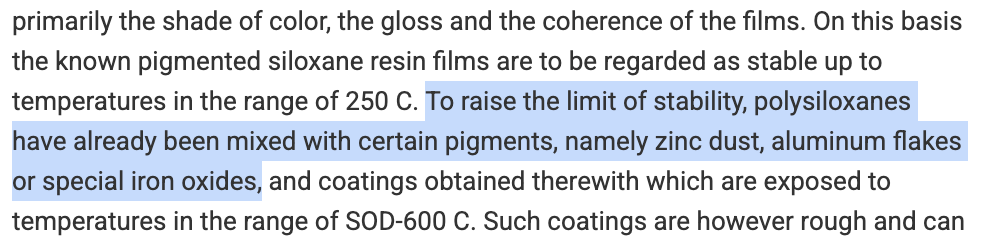
It also notes that these prior art paints are “suitable in some cases as protection against corrosion”
So there were known polysiloxane based anti-corrosion paints available prior to WTC steel production that contained the key components such as siloxane binders, zinc dust, aluminium flakes and special iron oxides.
AT NO POINT AM I SUGGESTING THAT THIS PAINT
PLAYED A ROLE IN THE CATASTROPHE
In other news, YouTube have put the following below my video

Appendix A - Some S.E. Jones research
For views over 1000 on ResearchGate:
70,015 - April 2009 - RIS 49 - Citations 39
Harrit, Niels & Farrer, Jeffrey & Jones, Steven & Ryan, Kevin & Legge, Frank & Farnsworth, Daniel & Roberts, Gregg & Gourley, James & Larsen, Bradley. (2009). “Active Thermitic Material Discovered in Dust from the 9/11 World Trade Center Catastrophe.” The Open Chemical Physics Journal. 2. 10.2174/1874412500902010007.
15,059 - June 2012 - RIS 26.6
Jones, Steven. (2012). “Were there Horses in the Americas before Columbus?.” Ancient American. 1. 5-6.
13,277 - April 2006 - RIS 7
Jones, Steven. (2006). “What Accounts for the Molten Metal Observed on 9/11/2001?.”
6,474 - January 2008 - RIS 14.7
Jones, Steven & Farrer, Jeffrey & Jenkins, Gregory & Legge, Frank & Gourley, James & Ryan, Kevin & Farnsworth, Daniel & Grabbe, Crockett. (2008). “Extremely high temperatures during the World Trade Center destruction.” Journal of 9/11 Studies.
5,644 - July 2016 - RIS 23.8
Jones, Steven & Korol, Robert & Szamboti, Anthony & Walter, Ted. (2016). “15 years later: On the physics of high-rise building collapses.” Europhysics News. 47. 21-26. 10.1051/epn/2016402.
4,077 - April 2008 - RIS 12.3
Jones, Steven & Legge, Frank & Ryan, Kevin & Szamboti, Anthony & Gourley, James. (2008). “Fourteen Points of Agreement with Official Government Reports on the World Trade Center Destruction.” The Open Civil Engineering Journal. 208. 35-40. 10.2174/1874149500802010035.
1,764 - January 2006 - RIS 7.5
Jones, Steven. (2006). “Why Indeed Did the WTC Buildings Completely Collapse?.”
1,634 - December 1992 - RIS 20.7
Jones, Steven & Berrondo, Manuel & Czirr, J. & Decker, D. & Harrison, Kent & Jensen, G. & Palmer, E. & Rees, L. & Shelton, D. & Taylor, Stuart & Vanfleet, H. & Wang, J.. (1992). “Investigation of cold nuclear fusion in condensed matter.” Progress Report Brigham Young Univ., Provo, UT.. 10.2172/7134320.1,165 - April 1989 - RIS 318.2 - Citations 637
Jones, Steven & Palmer, E. & Czirr, J. & DECKER, D. & Jensen, G. & Thorne, J. & Taylor, Stuart & Rafelski, Johann. (1989). “Observation of cold nuclear fusion in condensed matter.” Nature. 338. 10.1038/338737a0.1,082 - January 2005 - RIS 1.5
Jones, Steven. (2005). “Radiocarbon Dating of Bark Sample from Brewer’s Cave, Manti Area.” Ancient American. 15. 8.1,049 - ? - RIS 2.7
McGuire, Sarah & Jones, Steven. “Solar Cookers and Other Cooking Alternatives.”
Some with views under 1000 on ResearchGate:
55 - January 2000 - RIS 0.5
Jones, Steven. (2000). “Chasing anomalous signals: The cold fusion question.” Accountability in Research. 8. 55-58. 10.1080/08989620008573965.24 - July 1987 - RIS 20.4
Rafelski, Johann & Jones, Steven. (1987). “Cold Nuclear Fusion.” Sci. Am.; (United States). 257:1. 10.1038/scientificamerican0787-84.
Thank you Bob for the review of Jones' "nano thermite hypothesis" which my little (old) brain could follow. I agree, nano thermite hypothesis is dead - it never had much life anyway but Jones tried.
I do have one question though. Why were all of his samples composed only of paint chips? Was that because he used a magnet to pick up the bits for his samples to be tested, thus leaving behind other bits of dust untested? Somehow I feel like that might still include other bits of WTC material and this question was rolling through my mind during your entire presentation of the makeup of the dust. I kept waiting for an explanation but apparently one wasn't needed and I am still puzzled. TIA.
Excellent detective work, Bob. My view, based on witness testimony (my conversations with people who worked next to the WTC plaza at the time of the event, I lived in downtown NYC from 2010 to 2020 and grew up in the NY area) is that the jet fuel weakened the building structures. These buildings were in the Port Authority zone which has weaker building codes than NYC. Inspection videos from a few weeks before show poorly insulated metal beams. However, there were LENR/Coherent Energy Transformation effects in the area at the time, as seen in burning cars, at quite a distance away, with no intervening damage in objects. So the explosions must have been generated by resonant Ion Acoustic Waves creating tornado-like damage and dustification in the entire area with very specific electromagnetic destruction zones (just like we see with supercell tornadoes, ie. Charles Chandler.) I could be wrong, but this is my best assessment.