
O-Animator | The physics and observation it's based on...
and the release plan.

LIVESTREAM Sunday 26th July at 22:30 CET
Matsumoto Kickstarter books printed, first people getting their copies.
O-Animator - The physics and observation it’s based on and the release plan
Surprise gift for everyone!
The above image is a core in the Lorentz solver with a mainstream physics knot (side view).
O-Animator Commercial
The Fractal Toroidal Moment Simulator will be free to explore.
Producing with it is a licence.
O-Animator, the Fractal Toroidal Moment Simulator, is a physics-driven simulation instrument that runs entirely in the browser - the GPU field is verified against the repository’s numpy solvers on every page load, and nothing you see is hand-animated. With a Personal key you get all of that: every structure, every physics control, every visualisation, capture of stills and screen-quality video. Nothing about the science is ever locked. That includes the showpieces: release a structure into free flight and the Trace paints each core’s true path - as a plain line or a glowing plasma trail with sub-tor corkscrews, a Doppler-style direction glow, and tunable brightness, width and smoothing. The dressing is display-only; the paths underneath are always the derived motion, sampled finely enough to stay true at any time factor. Newest of the showpieces: Feeding - the structure eats, converting whatever matter reaches its cores into charged pair products that sustain it, with a live lifetime gauge calibrated against the two-day phantom observation and a “Fuel” preset category that walks the whole range from near-vacuum fade to condensed-matter runaway.
A Commercial key is for people taking the output somewhere: film work, publication, paid presentation, product material. It unlocks the production pipeline - the exports whose whole purpose is professional downstream use - and the right to use them commercially.
The science it stands on
O-Animator is not a particle toy: every structure and motion is computed from published physics, and the page proves it to you - the GPU field is checked against the repository’s reference solvers on every load (the badge in the header). These are the papers that built it, and what each one contributed:
R.P. Vishnevskii, Superconductivity of the Dirac Monopole (Sochi, 2008). [1] The primary source: the Dirac monopole as a self-organised electromagnetic vortex of coherently paired electrons - superconductivity without a lattice - in which magnetic charge nucleates and grows at the flow’s phase singularity, aggregating field intensity by logarithmic-spiral pair collection onto a central rotor under the orbiting-pair kinematic law. In the app this is the amplification stage of the story, and its premises enter as clearly-labelled inputs, never as solver logic. Translated from the Russian by Bob Greenyer, with the equations transcribed from the original page images and re-verified.
V.M. Dubovik & V.V. Tugushev, Toroid moments in electrodynamics and solid-state physics (Physics Reports 187, 1990). [2] The formal backbone: toroidal (anapole) moments - the third multipole family beside charge and magnetism. Behind the app’s far-field analysis and the anapole “dark drive”: configurations that carry energy and structure while radiating almost nothing.
N.E. Nevessky, Electromagnetic fields of current structures(Electricity Journal, 1993). [3] The recursion law for currents nested inside currents, order by order - the mathematical seed of the app’s fractal tree of tori. Translated by Bob Greenyer.
V.E. Zhvirblis, The Bagel Game (Chemistry and Life, 1995). [4] The observation: a three-level coiled structure with six sub-tori per level, and four handedness forms that self-assemble by chirality. The app’s canonical 6-spoke geometry, its L/R chirality modes, and the pair mode trace to this paper. Translated by Bob Greenyer.
G. Thorner, J.-M. Kiat, C. Bogicevic & I. Kornev, Axial hypertoroidal moment in a ferroelectric nanotorus (Phys. Rev. B 89, 2014). [5] Peer-reviewed hypertoroidal “apple” structures - the winding-within-winding geometry - and the left/right enantiomer pair the app’s handedness split reproduces.
A. Espinoza & A. Chubykalo, Mathematical Foundation of Kapitsa’s Hypothesis… (Foundations of Physics 33, 2003). [6] An exact standing solution of the free Maxwell equations - closed field cells whose energy sloshes internally and never escapes - putting hard mathematics under Kapitsa’s 1955 ball-lightning hypothesis [7]. The app’s standing-mode fields implement this solution exactly; a typo in the paper’s own radial functions (inconsistent between its two printings) was found and resolved by forcing Faraday’s law numerically before implementation.
A.F. Rañada, M. Soler & J.L. Trueba, A model of ball lightning as a magnetic knot with linked streamers (J. Geophys. Res. 103, 1998).[8] The second free-state candidate, complementary to the standing cell: a quasi-static magnetic knot in which every pair of field lines is linked, the field is exactly zero outside the ball, and the currents run on thin linked streamers occupying a millionth of the volume (resolving the hot-object/cold-object witness contradiction) - with conservation of magnetic helicity as the stability mechanism: “without linking and helicity there will be no ball lightning”. The app’s “knot” field source implements it with a linking-number slider, all four of the paper’s analytic anchors locked down by tests.
W.H. Bostick, Experimental Study of Plasmoids (Phys. Rev. 106, 1957; with Nature 179, 214). [9] The laboratory anchor: plasma fired across magnetic fields travels as structured tori - including a torus with a 45° helical winding - photographed in 1957. Wound toroids are an observed thing, not a rendering choice.
V. Nardi, W.H. Bostick, J. Feugeas & W. Prior, Internal structure of electron-beam filaments (Phys. Rev. A 22, 1980). [10] The empirical source of the app’s four-fold nesting ratio: plasma-focus filament photographs showing a large ring at four times the characteristic filament scale, a core of pinched electrons at its centre, and “spokes under surface” - a two-level hierarchy read directly off the plates, corroborated by Bob Greenyer’s own experiments. In the app the ratio enters as a cited observational input, never as derived logic, and the label keeps the caveat that repeating it over four levels extrapolates beyond the two observed.
D.N. Yue et al., Dynamics of moving electron vortices and magnetic ring in laser plasma interaction (Phys. Plasmas 28, 2021). [11] The modern mainstream anchor: particle-in-cell simulations of laser-plasma interaction in which electron-vortex pairs form a "smoke-ring-like" magnetic ring at kilotesla strength, trapped ambient electrons compose its inner current, and the ring obeys B·R = constant as it shrinks (frozen-in flux at nearly fixed tube thickness). The app's field-scaling law, collapse behaviour and capture current are implemented from this paper. Its conservation law and Vishnevskii's kinematic law [1] belong to the same scaling class - both make amplitude rise as 1/size under the similarity transform the app's Collapse control performs - but they are related, not identical: Yue's holds ampere-turns fixed, Vishnevskii's holds angular momentum fixed, and through the absolute system's B = Ω the two differ by one power of radius. Which a nested hierarchy should obey is a real open question; the app takes Yue's branch and
PHYSICS.mdrecords the choice. (Scale honesty: micron-scale plasma physics, adduced as evidence for the flow forms, not as proof of the model.)D. Fryberger, A Ball Lightning Model as a Possible Explanation of Recently Reported Cavity Lights (SLAC-PUB-13583, 2009). [13] Takes on the classical no-go head on: a luminous object that stays coherent for a minute or more is an apparent violation of the virial theorem, and his analysis rules out solid, liquid, gas and ordinary plasma as what such objects could be. His answer works within the theorem, not against it: the core’s field energy exerts exactly the radial expansion force the theorem demands, and a counter-force derived from dyangular momentum (the dyality symmetry of Maxwell theory extended with magnetic charge) contains it, giving a stable, localised energy-minimum equilibrium “without violating the virial theorem”. That is the virial solution in the sense this project uses the phrase: self-coherent field structures are possible, but only with the right internal circulation to hold them - which in O-Animator’s terms is the closed-Poynting, nested configuration the simulator lets you build and probe. His 1994 companion paper (A Model for Ball Lightning, SLAC-PUB-6473, archived with the project) [15] goes further and names the energy source outright: nucleon decay catalysed by the core, at a rate proportional to the local density of matter - the seed of the app’s feeding stage.
Two more inputs are data rather than theory. The Common Species in the Interstellar Medium table [14] - abundances, masses, and gas-phase magnetic character - is reproduced verbatim in the app’s Medium panel and drives its species physics: matter in the simulator sorts not only by charge and mass but by magnetic type, to the point that neutral oxygen (which the Lorentz force cannot touch) visibly collects on the high-field cores when the susceptibility drift is switched on. And a set of overlay plates and photographs - cavitation bubbles in water, SEM displacement patterns on aluminium foil, cavitation marks on steel, a laser-cut smoke vortex in air - shows one and the same 2-D flow construction fitting all four media: the medium-independence exhibit, labelled as visual reference, not as an equation source.
Supporting reads in the same lineage - Afanasiev & Dubovik on remarkable charge-current configurations (1998) [12] - are archived with the project alongside the full source-provenance ledger (PHYSICS.md), which records for every equation whether it is derived, asserted, or observed. That distinction is the project’s discipline, and the app inherits it.
What building it found
The papers are the inputs; the tool then computed findings of its own - none assumed, several surprising, every one locked down by a test in the repository:
The amplitude law is forced, not chosen. Requiring Yue's B·R = constant across the hierarchy forces constant ampere-turns at every level - the field intensification with depth is pure geometry, nothing tuned. Vishnevskii's kinematic law [1] and Yue's MHD conservation law [11] land in the same scaling class without being the same equation, and the difference is a genuine fork: Yue's branch (the one implemented) lets the flux per level shrink with depth, Vishnevskii's would hold it at one quantum. The app says which it took, in code and in the ledger.
Four computations converge on the counter-rotating twin. An unexplained second core inherited from the prior artwork acquires a physical identity - the root ring’s dipole partner - because four independent calculations (dipole cancellation, far-field decay steepening, an added null direction, and phase closure becoming possible at all) all point at it.
Toroid moments telescope. A counter-rotating pair generates the next level’s toroid moment in the moment algebra itself [2], with an exact 8/9 amplitude knob that statics and radiation minimisation discover independently.
The closure threshold was computed, not assumed. The first radiation-dark drive appears at tor order 3 - Zhvirblis’s 1,2,3-tor [4] - and a fourth order widens the dark subspace rather than deepening it: closure at three, a fourth as a lock. The optimal phases read out Zhvirblis’s own quadrature mechanism.
Darkness and protection trade off. Radiative quiet and topological (helicity [8]) protection cannot both be maximised by handedness alone - a computed division of labour.
The phantom needs the medium - proved by exclusion. In vacuum the undriven field drains ballistically in one light-crossing; two-day persistence [4] cannot be vacuum electromagnetism. The amplification loop - captured electrons deposit current, current makes field, field captures more - runs live in the lab, its runaway honestly labelled as the instability it is.
The structure can feed - and the budget closes. Fryberger’s 1994 paper [15] names the ball-lightning energy source outright: nucleon decay catalysed by the core, at a rate proportional to the local density of matter. The app carries that as a feeding budget with exactly ONE fitted constant - calibrated so ambient air sustains the phantom for Zhvirblis’s observed two days [4] - after which every prediction is a parameter-free density ratio: at equal pressure xenon (131 nucleons per atom) crosses self-sustaining where air (29) fades and helium (4) starves, and condensed-matter contact (iron, lead: ~10,000 × air) runs away, labelled the instability it is. Persistence ordered by baryon density alone - Xe > air > He - is the model’s testable signature: one gas swap separates it from every rival explanation. In the app, baryon tracers reaching a core visibly convert to relativistic lepton pairs that rejoin the medium: the amplification loop, closed with fuel. The idea’s lineage is wider than one paper: monopole-catalysed nucleon decay is mainstream theory [16], Cramer popularised its implications in 1984 [17], and a CIA-archived 1992 Moscow interview already claimed matter-conversion propulsion - one kilogram of iron for an interstellar journey [18] - kept as documentary lineage, not evidence.
What a Commercial key unlocks
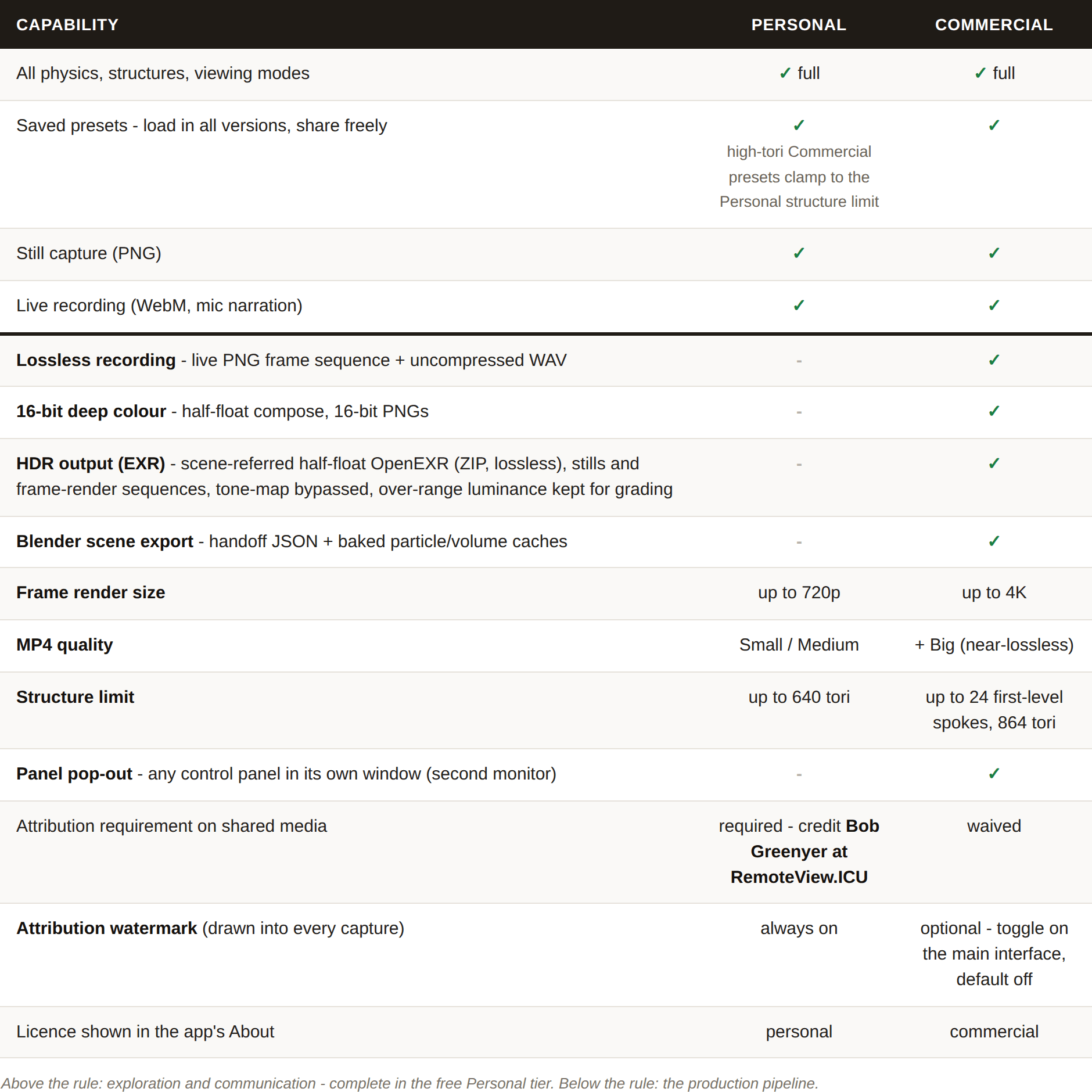
Rationale for the split. Everything above the line is exploration and communication - the reasons the simulator exists - and stays complete in the Personal tier, including screen-quality recording so anyone can share what they found. Everything below the line exists only to feed a professional pipeline: bit-exact frames for an edit suite, 16-bit plates and scene-referred EXRs for grading, caches for Blender, 4K masters. Those are the Commercial tier.
How it behaves in the app
Commercial-only controls are visible but greyed, marked “COMMERCIAL”, and inert on a Personal key; clicking one shows a short notice naming the feature and the licence it needs.
Locked frame sizes and the Big bitrate appear in their menus, labelled, but cannot be selected.
A Commercial key entered at the wall unlocks everything instantly - same build, no separate download. The About panel names the licensee and licence.
Patron keys unlock everything Commercial does, and the patron’s name or company appears in the About panel’s patron roll, shown to every user of the app.
Pricing and availability

Licences are per seat: each key is minted against one person’s email address and works only with it (the About panel shows the address the licence was issued to). The free version releases in the fourth quarter of 2026.
Purchase page: coming soon - until then, contact Bob Greenyer (MFMP / RemoteView.ICU).
References
R.P. Vishnevskii, Сверхпроводимость монополя Дирака («Superconductivity of the Dirac Monopole»), Sochi, May 2008. Original (Russian): lightdynamics.narod.ru. English translation: Bob Greenyer.
V.M. Dubovik & V.V. Tugushev, “Toroid moments in electrodynamics and solid-state physics,” Physics Reports 187(4), 145-202 (1990).
N.E. Nevessky, “Electromagnetic fields of current structures,” Электричество(Electricity) 1993 №12, 49-52. English translation: Bob Greenyer.
V.E. Zhvirblis, «Игра в бублики» (”The Bagel Game”), Химия и жизнь(Chemistry and Life) 1995, 10-15. English translation: Bob Greenyer.
G. Thorner, J.-M. Kiat, C. Bogicevic & I. Kornev, “Axial hypertoroidal moment in a ferroelectric nanotorus: a way to switch local polarization,” Phys. Rev. B 89, 220103(R) (2014).
A.E. Espinoza & A. Chubykalo, “Mathematical Foundation of Kapitsa’s Hypothesis about the Origin and Structure of Ball Lightning,” Foundations of Physics 33(5), 863-873 (2003).
P.L. Kapitsa, Dokl. Akad. Nauk USSR 101, 245 (1955) - the hypothesis formalised in [6].
A.F. Rañada, M. Soler & J.L. Trueba, “A model of ball lightning as a magnetic knot with linked streamers,” J. Geophys. Res. 103(D18), 23309-23313 (1998), doi:10.1029/98JD01539.
W.H. Bostick, “Experimental Study of Plasmoids,” Phys. Rev. 106, 404 (1957); and “Simulation of Astrophysical Processes in the Laboratory,” Nature 179, 214 (1957).
V. Nardi, W.H. Bostick, J. Feugeas & W. Prior, “Internal structure of electron-beam filaments,” Phys. Rev. A 22, 2211 (1980).
D.N. Yue, M. Chen, P.F. Geng, X.H. Yuan, S.M. Weng, S.S. Bulanov, S.V. Bulanov, K. Mima, Z.M. Sheng & J. Zhang, “Dynamics of moving electron vortices and magnetic ring in laser plasma interaction,” Phys. Plasmas 28, 042303 (2021).
G.N. Afanasiev & V.M. Dubovik, “Some remarkable charge-current configurations,” Phys. Part. Nucl. 29(4) (1998); Russian original Fiz. Élem. Chastits At. Yadra 29, 891-945.
D. Fryberger, “A Ball Lightning Model as a Possible Explanation of Recently Reported Cavity Lights,” SLAC-PUB-13583, April 2009.
Common Species in the Interstellar Medium - abundance, mass, and gas-phase magnetic behaviour table; archived with the project and reproduced in the app’s Medium panel.
D. Fryberger, “A Model for Ball Lightning,” SLAC-PUB-6473, October 1994; invited talk, First Int. Workshop on the Unidentified Atmospheric Light Phenomenon in Hessdalen (March 1994). The energy-source companion to [13]; archived with the project.
V.A. Rubakov, JETP Lett. 33, 644 (1981); C.G. Callan, Phys. Rev. D 25, 2141 (1982) - monopole-catalysed nucleon decay, the mainstream precedent.
J.G. Cramer, “When Proton Meets Monopole,” The Alternate View, Analog(1984); npl.washington.edu/av/altvw01.html - popular exposition of [16].
V. Lagovskiy (interviewing V.D. Shabetnik), “Sensation: Flight to Alpha-Centaurus,” Rabochaya Tribuna (Moscow), 16 June 1992; JPRS translation JPRS-UEQ-92-010; CIA reading room DOC_0005516643 (released 2010). Documentary lineage only; archived with the project.
Hi Bob — I’ve been trying to use AI to understand all this and the AI is saying there seems to be a discrepancy?
When checking the two scaling laws against each other. Yue gets B×R = const (field falls as 1/R, ring radius, tube thickness fixed). Vishnevskii’s r·V = const with Ω = B gives B×r² = const (field falls as 1/r²). Different exponents — so as written they’re not the same statement. Is there an identification between the radii I’m missing, or do you mean they’re both frozen-in-flux laws rather than literally the same formula? Keen to get clarity on this one.
Any chance of adding dark matter flows to the O-Animator simulation? This might be helpful in seeing how spherical ball lightning shapes transform into toroids and fractal bagels. Thanks.