
"Energy Amplifier"
Dr. George Egely's 'Exotic Vacuum Object' based device

I had an opportunity to see one of Dr. George Egely's 'Exotic Vacuum Object' based devices under test by former MFMP volunteer Bob Higgins. Moments after switching on, the output thermal energy, shown in a calibrated resistor/thermometer, exceeded that on the equivalent input side. Whilst crude it is indicative of something going on.
Optical Overview
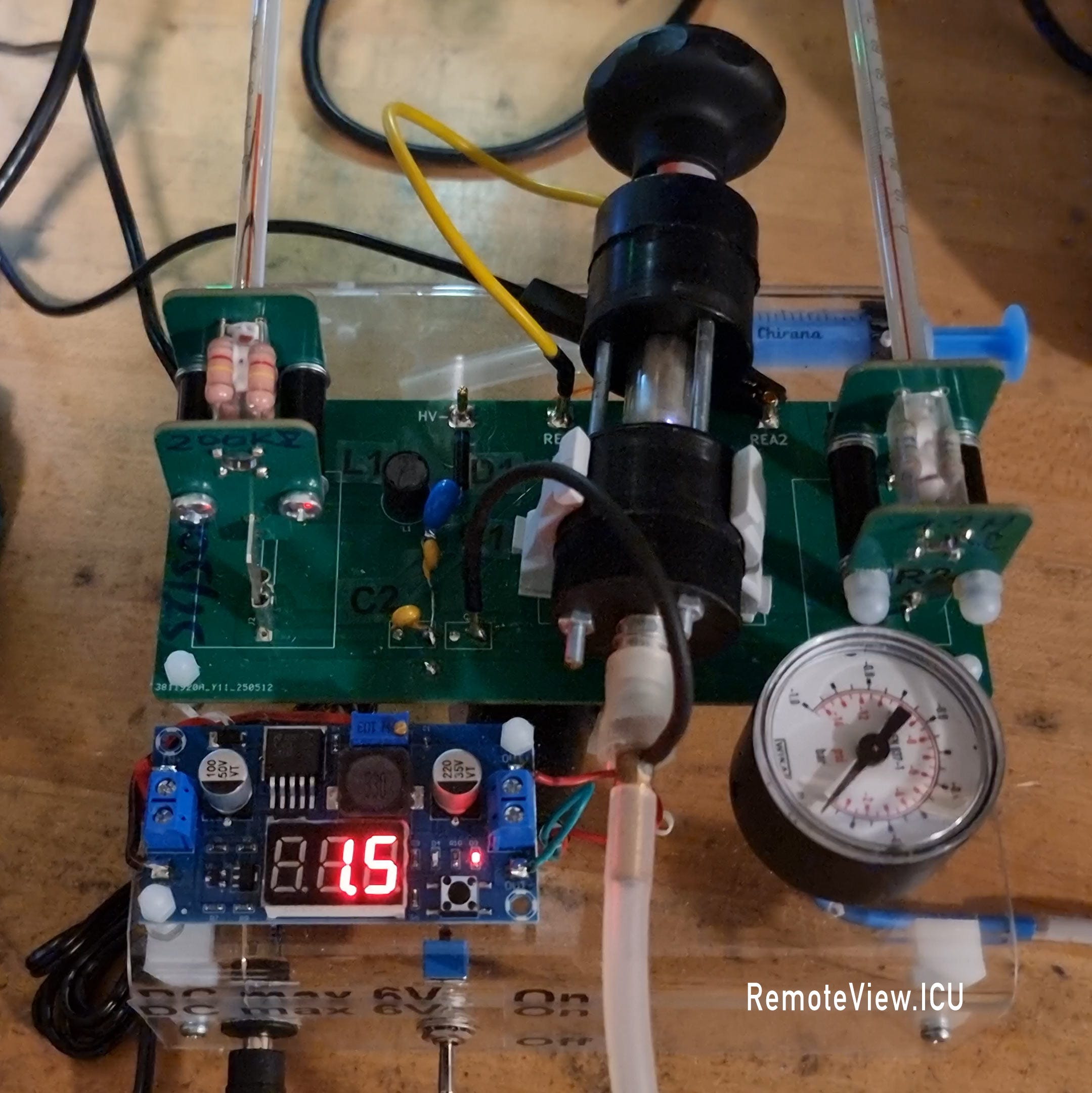
The power regulator (blue board) in the bottom left takes input voltage (in this case 4V) and regulates it to the necessary 1.5V to power the HV generator board (under the perspex apparatus support. On could presumably run it of any stable 1.5V supply - like a Lithium battery for instance.
Thermal Imaging
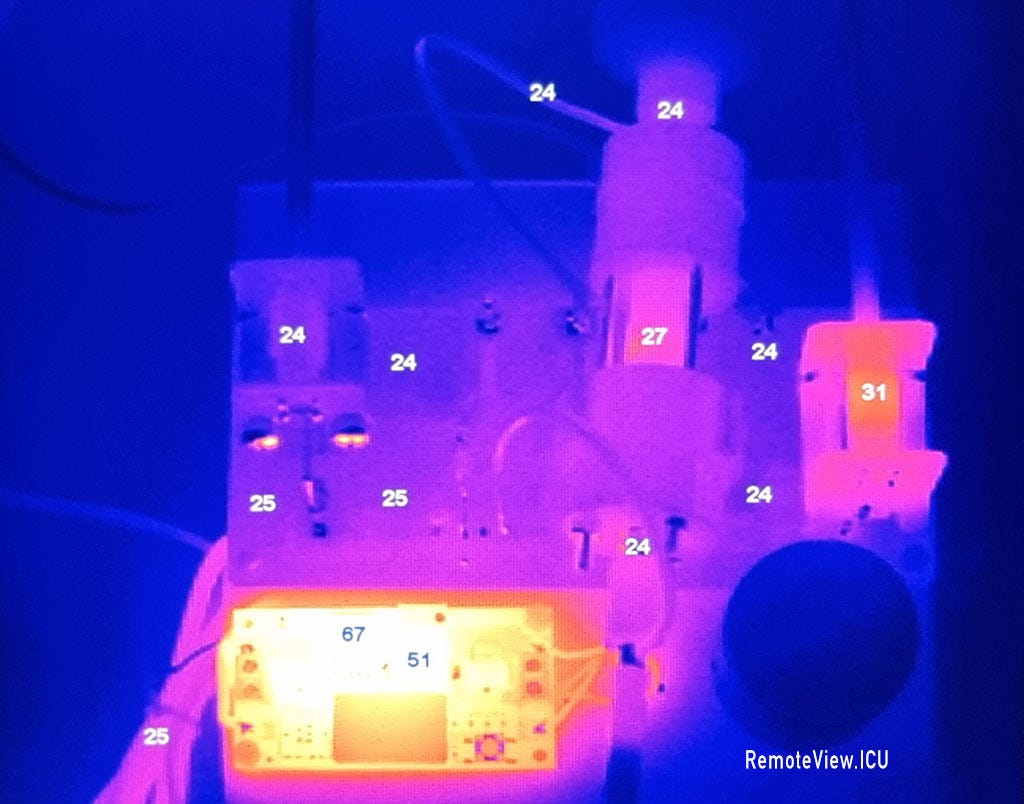
NOTE: This thermal image allocates only one emissivity for the whole frame so temperatures should not be taken as exact. The power regulator is clearly very wasteful thought as one can see. The actual reactor zone - indicated at 27ºC, is actually warmer on the anode side, indicating the charge carriers are negative.
Detail Gallery


US2025056706 -- APPARATUS AND METHODS FOR GENERATING CONDENSED PLASMOIDSInventor: EGELY GYORGY?[HU] // Applicant: GAIA SECURITIES LTD?[NZ]
pparatus (1) for generating condensed plasmoids. The apparatus (1) includes a reactor (4) with a chamber (15) for containing a reactant gas. A cathode (17) and an anode (18) extend into the chamber (15) with an interelectrode gap formed between the electrodes (17,18). The electrodes (17, 18) are connectable to an electrical circuit (13) having a power supply (12) for applying an electric potential difference between the electrodes (17, 18) to form a plasma of the reactant gas in the interelectrode gap (19). An interelectrode discharge (21) traverses the interelectrode gap (19). The cathode (17) has an electron discharge material (22) from which clusters (63) of electrons emit, thereby generating condensed plasmoids (62) in the interelectrode discharge (21). The electron discharge material (22) includes a semiconductor material.
US2014126679 -- RENEWABLE ENERGY PRODUCTION PROCESS WITH A DEVICE FEATURING RESONANT NANO-DUST PLASMA, A CAVITY RESONATOR AND AN ACOUSTIC RESONATOR
Inventor: EGELY GYÖRGY
The invention is a renewable energy production process with resonant nano-dust plasma, with the application of a cavity resonator and an acoustic resonator. During the process the acoustic resonator is placed inside the cavity resonator, and create a series of acoustic resonances with a complex plasma made of sub-micron sized carbon dust, hydrogen isotopes and other gases between 10 Pa and 500 kPa at about 2.000° C., thus creating oscillations and thus plasmon polaritons on the surface of carbon dust particles oscillating between 10 kHz-5 GHz and in the terahertz range, which in turn produces heat or electric energy, or creates a series of nuclear transmutations. The invention is an embodiment producing renewable heat, formed by a cavity resonator (30) excited by electromagnetic fields, and an acoustic resonator (10). In the acoustic resonator (10) operated with a number of acoustic resonances, there are nano-sized dust particles (1). The electromagnetic cavity resonator (30) is cylindrical, spherical or rectangular with mirror-like internal walls (31), inside of which the cylindrical or spherical acoustic resonator (10) suitably made of heat resistant and electrically insulating material is mounted.
US2014098920 -- METHOD FOR THE PRODUCTION OF RENEWABLE HEAT ENERGY
The subject of the invention is a process for heat production with nuclear interactions. During the process the gas is pumped through a stack of nanoparticles in a device featuring an internal and an external chamber via an inlet and an outlet opening, and the process is initiated by heating the device. Further, the subject of the invention is a device accomplishing said process. The device has an interconnected internal chamber, and surrounding said chamber there is an external chamber having at least one inlet and one exit opening. There are nanoparticles in the internal chamber. There is an impermeable wall between the two said chambers. The internal chamber is separated from the exit opening by a heat resistant, porous ceramic wall. There is a heating element on the internal side wall.
I like this more than overunity or excess heat or free energy: energy amplification